
In Brief: Most team brainstorms fail because the format favours confident voices, not better ideas. Fix the structure and you fix the output. A well-run team brainstorm reliably surfaces ideas that no brief or solo session would find.
Most brainstorms fail before anyone picks up a marker. The session gets booked, the room fills up, and three people do all the talking while everyone else waits for it to be over. If that sounds familiar, the problem is not the team.
A well-run team brainstorm is one of the most reliable ways to surface ideas that would never emerge from a top-down brief or a solo thinking session. But most organisations run them badly, then conclude that brainstorming does not work. It works. The format is just usually wrong.
Why the Default Format Lets Most People Down
The classic setup is a whiteboard, a facilitator with a pen, and an open invitation to shout out ideas. What happens in practice is that the most confident voices fill the space, anchoring the group around whatever gets written up first. Everyone else either agrees or says nothing. You leave with a list that reflects three people’s thinking, dressed up as a group effort.
There is a concept in psychology called anchoring bias: once a number or idea is stated aloud, it shapes everything that follows. In a brainstorm, the first idea on the board becomes the gravitational centre. Later contributions orbit it rather than break from it. This is not a personality problem. It is a structural one, and it can be fixed with a bit of deliberate design.
The other issue is status. In most workplaces, junior staff read the room before they speak. If the senior person in the room has already offered an opinion, disagreeing with it requires social courage that most people simply will not expend in a group setting. You lose the most interesting ideas before they are ever voiced.
How to Run a Team Brainstorm That Actually Works
The goal is not to make everyone feel included. The goal is to get the best ideas out, wherever they are sitting in the room. These two things sometimes overlap, but the second is the one that matters for the business.
- Send the prompt in advance. Give people the question or challenge at least 24 hours before the session. Ask them to arrive with three ideas written down, privately. This prevents cold-start paralysis and means the first five minutes are not wasted on people trying to understand what they are being asked.
- Start with silent individual generation. Even with prep, begin the session with five to ten minutes of quiet writing. No talking, no sharing. Everyone adds to or refines their thinking on paper before anything goes public. This breaks the anchoring problem at source.
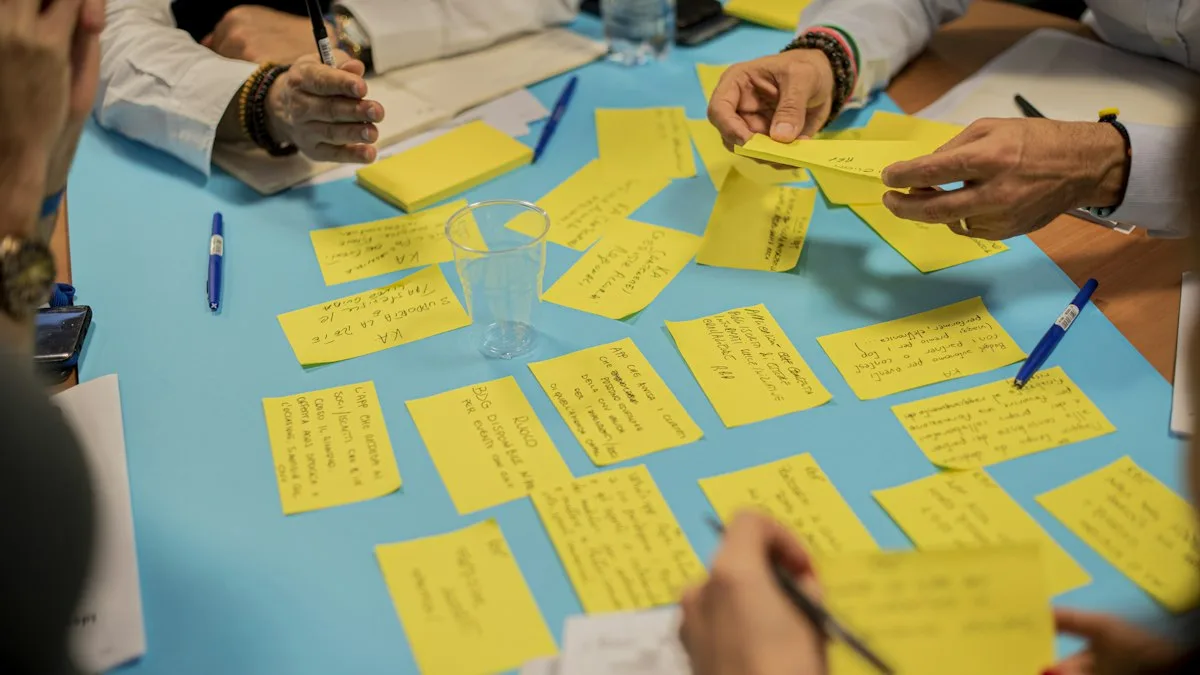
- Collect ideas before discussing them. Go around the room and have each person read one idea at a time, rotating until all ideas are on the board. No commentary during collection. No ‘yes, and’ or ‘the issue with that is’. Just ideas, listed out. You can have twelve ideas on the board in under ten minutes this way.
- Cluster and vote silently. Once everything is visible, give everyone sticky dots or a simple show of hands to indicate which ideas they think are worth pursuing. Do the voting before any discussion. This captures honest reactions before the group dynamic reasserts itself.
- Discuss the shortlist, not the full list. Use the remaining time to explore the ideas that got attention. This is where conversation is actually useful. You are no longer generating; you are stress-testing and developing.
Getting Employee Ideas from the People Who Are Usually Quiet
The people with the most grounded operational insight are often the ones least likely to speak in a group setting. A customer service rep who handles complaints all day knows things about product friction that no strategist does. A warehouse supervisor who has worked around a broken process for six months has almost certainly already thought of the fix. The question is whether the environment makes it possible for them to say so.
Anonymous input channels work well alongside live sessions. A simple shared document where people can add ideas before and after the brainstorm, without attribution, catches the contributions that get filtered out in the room. Not everyone needs to be an extrovert to have a worthwhile thought.
I ran a session a few years ago where we used this approach and the idea that made it into production came from someone who had not said a single word during the live session. She had typed it into the shared document that evening. We would have missed it entirely under the old format. That is a genuine structural failure, not a people problem.
Cross-functional Mixing
Brainstorms within a single team tend to produce ideas that fit within that team’s existing assumptions. Mixing people from different functions, even briefly, introduces friction that is actually useful. Someone from finance sitting in on a marketing brainstorm asks different questions. Someone from operations sees a product idea and immediately spots the logistics problem. That kind of cross-pollination does not require a formal programme. It just requires inviting the right people.
Collaborative Innovation for SMEs: What Larger Companies Get Wrong
Collaborative innovation in an SME context has one significant advantage over large organisations: the people in the room are usually closer to the actual work. There is less translation required between the idea and the reality. A small business can take something off a brainstorm and test it within a week. A large company might need six months of internal approvals first.
Where smaller businesses tend to fall down is in making brainstorming feel safe. Without a culture that genuinely rewards contribution, people second-guess themselves before they speak. The fix is not a workshop about psychological safety. It is consistent behaviour from leadership: following up on ideas, crediting them publicly, and being visibly willing to be wrong in front of the team. That takes longer than a single brainstorm session to establish, but it compounds.
Large businesses invest heavily in idea management platforms and structured innovation programmes. SMEs rarely need any of that. A shared document, a clear prompt, and a facilitator who knows when to stop talking will outperform most enterprise tools in a team of fifteen.
The Bit That Usually Gets Skipped
Most brainstorm sessions end with a list on a whiteboard and an implicit agreement that someone will do something with it. Nobody is sure who. The list gets photographed, the photo gets filed, and nothing happens. Three months later, someone has the same session again.
Before the room clears, assign a named owner to each shortlisted idea and a date by which they will report back. Not a deadline for execution. Just a date to say: ‘I looked at this, and here is what I think’. That single step separates organisations that generate ideas from ones that actually use them.
Frequently Asked Questions
How long should a brainstorm session be?
Sixty to ninety minutes is usually enough. Beyond that, energy drops and the ideas that emerge in the final half hour rarely justify the time. If you need more than ninety minutes, the question is probably too broad. Split it into two sessions with a clearer focus for each.
How many people should be in a brainstorm?
Between five and eight people tends to work best. Fewer than five and you lose the diversity of perspective. More than eight and the room becomes difficult to manage without a skilled facilitator, and quieter participants effectively disappear. If the team is larger, split into groups and then share outputs.
Should the most senior person attend?
Sometimes, but not always in the generation phase. Senior presence in an early brainstorm can suppress ideas before they are formed. One option is to run the initial session without them, present the shortlist for input, and then bring them in at the evaluation stage where their perspective is genuinely useful rather than inhibiting.
What makes a good brainstorm prompt?
Specific and bounded. ‘How might we reduce customer churn in the first thirty days?’ is a useful prompt. ‘How might we improve the business?’ is not. The tighter the question, the more useful the answers. Broad prompts produce broad ideas that are hard to act on.
The Bottom Line
- Send the prompt before the session and ask people to prepare ideas privately.
- Start with silent generation to prevent early anchoring.
- Collect all ideas before any discussion begins.
- Vote before you talk. Discussion should follow reaction, not shape it.
- Create anonymous input channels for the ideas that never make it into the room.
- Assign named owners to shortlisted ideas before the session ends.
If the same three people dominate every brainstorm in your organisation, the question is not how to silence them. It is what you are doing that makes everyone else feel their ideas are not worth the risk.