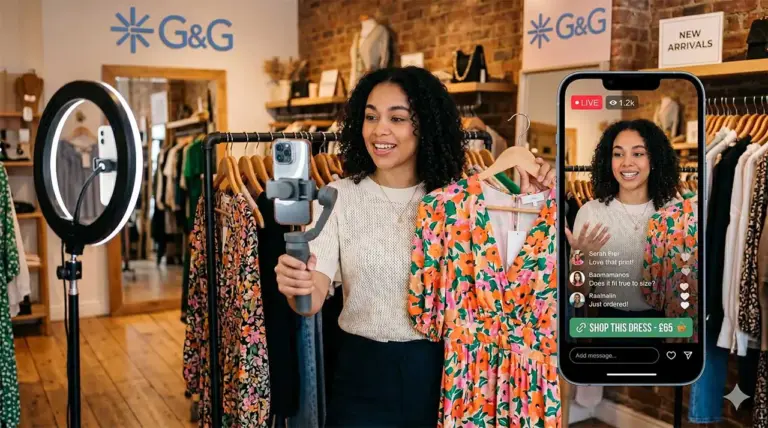

Video shopping is no longer a novelty sitting at the edge of retail strategy. Brands like Aldo and Nordstrom have been running live shopping examples that convert browsers into buyers at rates that make traditional e-commerce funnels look sluggish by comparison.
That is not hype. The shift is measurable, and the mechanics behind it are worth understanding properly rather than just admiring from a distance.
What Video Shopping Actually Means
Before going further, it helps to be precise about the term. Video shopping refers to any retail experience where a customer can browse, ask questions, and complete a purchase within or directly alongside a video format. That includes pre-recorded shoppable content, one-to-one virtual appointments, and live-streamed events where products are demonstrated in real time. The formats behave differently and serve different parts of the buying journey.
Live shopping specifically involves a broadcast, usually hosted on a brand’s own platform, social media, or a third-party service, where a host presents products and viewers can interact, ask questions, and buy without leaving the stream. The social pressure is deliberate. Scarcity cues, real-time reactions, and direct conversation create a buying environment that static product pages simply cannot replicate.
Live Shopping Examples That Show How It Works in Practice
Aldo’s approach is one of the cleaner video shopping case studies in Western retail. The footwear brand ran live shopping events through its own site as well as via TikTok, using hosts who were genuinely familiar with the product range rather than generic presenters reading from a script. The difference in credibility is noticeable. When someone can answer an off-the-cuff question about whether a boot runs narrow without hesitating, it removes one of the biggest barriers to buying footwear online: the fit anxiety that lives in the gap between a product description and a real foot.
Nordstrom took a slightly different angle. The department store leant into its existing personal styling culture and extended it into video, offering customers live access to stylists who could pull together outfit combinations on camera and link directly to purchase. This was not a dramatic departure for Nordstrom; it was an extension of something the brand already did well in physical stores. That continuity matters. The video format worked partly because the behaviour it asked of customers was already familiar to them.
What both cases share is an understanding that the video is not the point. The interaction is the point. The video is just the medium that makes real-time conversation possible at scale.
Why Retail Retail Innovation in Video Shopping Is Outpacing Expectations
The scepticism around live shopping in Western markets has been persistent. For years, the assumption was that live commerce was a Chinese phenomenon, driven by platforms like Taobao Live, and would not translate to European or North American audiences with the same force. That assumption is being quietly revised.
The retail innovation happening right now is not about copying a format wholesale. It is about identifying which elements of live commerce solve real friction points for specific customer groups. Returns are expensive. Fit is hard to communicate through photography. Trust in unknown brands is difficult to build through static copy. Video shopping addresses all three, not abstractly but in practice, during the session itself.
There is also a staffing dimension that gets underreported. Brands with strong in-store talent have found that live shopping gives those employees a platform that extends their reach considerably. A skilled stylist in a Nordstrom store can help perhaps a dozen customers in a day. The same person hosting a live event can interact with hundreds. That is not a replacement for in-store service; it is a different kind of leverage that does not require opening new locations.
The Mechanics Behind the Conversion Rates
One thing I have noticed when looking at video shopping case studies is how often the conversion uplift gets credited entirely to the format, when the actual driver is usually something more specific. It tends to be the question-and-answer dynamic.
A customer watching a live stream who types ‘does this come in wide fit?’ and gets an immediate, accurate answer from a host is no longer just watching a product. They are in a conversation about their actual need. That shift in framing changes the psychology of the interaction from passive viewing to active consideration. The purchase that follows is not an impulse buy in the traditional sense; it is a decision reached through a compressed but genuine sales conversation.
Pre-recorded shoppable video works differently. It removes the time pressure and the social element, but it lets customers move at their own pace, revisit moments, and click through to specific products without friction. Brands that have tried both formats tend to use them for different goals: live for launches and engagement, shoppable on-demand content for evergreen discovery.
What Other Retailers Can Learn From These Video Shopping Case Studies
The temptation when looking at brands like Aldo and Nordstrom is to focus on the scale of their operations and conclude that video shopping is something only well-resourced retailers can do. That conclusion is worth challenging. Both brands started with small, relatively low-production events before investing more significantly. The production values in early sessions were modest. What mattered was the quality of the host and the relevance of the product selection.
A smaller retailer with a focused product range and a member of staff who genuinely knows the stock is arguably better positioned for this format than a large department store trying to cover every category. Specificity is an advantage in live shopping. A boutique running a session about one new collection, where the host can speak in detail about each piece, is more credible than a broad-catalogue event where depth gets sacrificed for variety.
The technology barrier is also lower than it was two years ago. Platforms built specifically for live commerce have made the hosting, cart integration, and replay functionality accessible to brands without dedicated development teams. The operational complexity has not disappeared, but it has reduced considerably.
The Questions Worth Asking Before Committing
Video shopping is not appropriate for every retail context. Products that require extended consideration, involve significant personalisation, or carry high return rates for reasons unrelated to information gaps may not benefit from a live format. The format works best when the main barrier to purchase is trust or product understanding, and when a conversation can genuinely resolve that barrier in a short window.
It is also worth being honest about what the analytics will look like early on. Audience numbers for initial live events are typically modest. Judging the success of a first session by viewership alone misses the point. The relevant metrics are conversion rate among viewers, average order value compared to site average, and post-event engagement. Those numbers tend to be more encouraging than the raw audience figures suggest.
Key Takeaways
- Aldo and Nordstrom have built credible live shopping programmes by extending existing strengths into a new format rather than starting from scratch.
- The conversion uplift in video shopping comes primarily from real-time question-and-answer dynamics, not from the video format itself.
- Live and shoppable on-demand video serve different purposes and work best when used together as part of a broader content strategy.
- Smaller retailers with focused ranges and knowledgeable staff can compete effectively in this space without large production budgets.
- Early event metrics should prioritise conversion rate and order value over audience size.
The more interesting question, as this space matures, is whether the brands that have invested in live shopping talent will find that capability spreading into areas they did not originally plan for: customer service, community building, or even product development feedback. The session that started as a sales event has a habit of becoming something more complicated over time.